

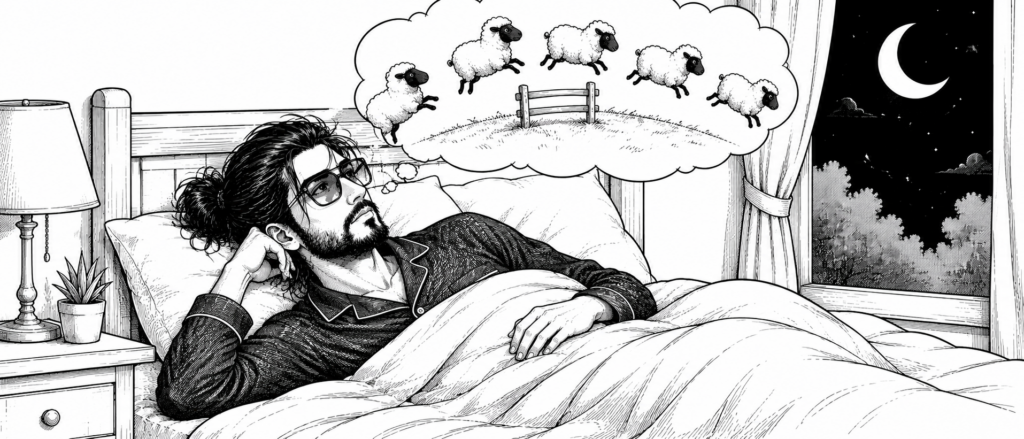
In 2002, researchers Allison Harvey and Suzanna Payne at Oxford University tested this directly. They split 50 people with insomnia into three groups. One counted sheep. One imagined a calming scene, like a beach or a quiet walk in nature. One got no instructions at all.
The imagery group fell asleep 20 minutes faster than usual. The sheep counters did not improve. If anything, they took slightly longer than the group with no technique at all. The study was published in Behaviour Research and Therapy.
Why counting sheep fails
Counting sheep is too simple. It does not take up enough mental space to block out your worries.
Harvey put it directly. Picturing a relaxing scene takes up more brain space than picturing sheep. When a task is that easy, your mind wanders back to tomorrow’s deadline or whatever is keeping you up. You end up half counting and half worrying, which is worse than doing nothing.
Why imagery works better
A calming scene works because it holds your attention without raising your stress levels. You are focused on the sound of the waves or the feel of the ground under your feet. There is enough detail to keep your mind busy, but nothing stressful enough to keep you alert.
This is the balance that makes a technique effective. Too boring and your mind drifts to anxious thoughts. Too stimulating and it keeps you awake.
What to do instead
- Picture a real or imagined walk. Something like a forest trail, a beach, or a quiet park works well.
- Add sensory detail. Notice the temperature of the air, the sound of your footsteps, the smell around you. The more detail, the more it holds your attention.
- Keep the scene calm. Avoid anything with tension or a plot. You want atmosphere, not a story.
- Try cognitive shuffling if imagery alone does not work. Pick a random word, then think of unrelated images that start with each letter. This mimics the loose, random thinking your brain does right before sleep.
- Give it time. If your mind drifts back to your worries, gently return to the scene. This is normal and part of how the technique works.
The bottom line
Counting sheep is a nice idea, but it does not hold up in research. Slow, detailed imagery gives your brain enough to focus on without triggering stress, and that is what actually helps you fall asleep faster.
References
1. Harvey, A.G., & Payne, S. (2002). The management of unwanted pre-sleep thoughts in insomnia: Distraction with imagery versus general distraction. Behaviour Research and Therapy.
2. CNN. Counting sheep: Who came up with this old sleep tip, and does it work?
3. Wikipedia. Counting sheep.