
Most nights you wake up to air blowing across your eyes or you feel a cold jet hitting your neck. Sometimes your partner mentions hearing a hissing sound coming from your side of the bed. You might also notice red marks where the mask straps have been pressing too hard, since you keep tightening them to try to stop the leak. Some mornings you wake up with dry, irritated eyes from air blowing upward under the mask cushion.
Why this happens
Leaks usually come down to fit, not effort. A mask that’s the wrong size or shape for your face will leak no matter how tight you make it, and over-tightening often makes leaks worse by distorting the cushion seal instead of fixing it. Other common causes include a worn-out or stretched-out cushion, facial hair breaking the seal, sleeping on your side or stomach and shifting the mask off center, or opening your mouth at night if you’re on a nasal mask or nasal pillows. Higher pressure settings can also push more air out through small gaps, so if your pressure was recently increased, that could be part of it too.
Steps to troubleshoot
- Check the cushion for wear, cracks, or stretched silicone. Most cushions need replacing every 1 to 3 months even if they look fine, sometimes even earlier
- Try refitting the mask while lying down in your actual sleep position, not just standing in front of a mirror
- Loosen the straps first before tightening. A looser fit that seals well beats a tight fit that’s distorting the cushion
- If you sleep on your side, ask about a mask designed for side sleepers or a low-profile cushion.
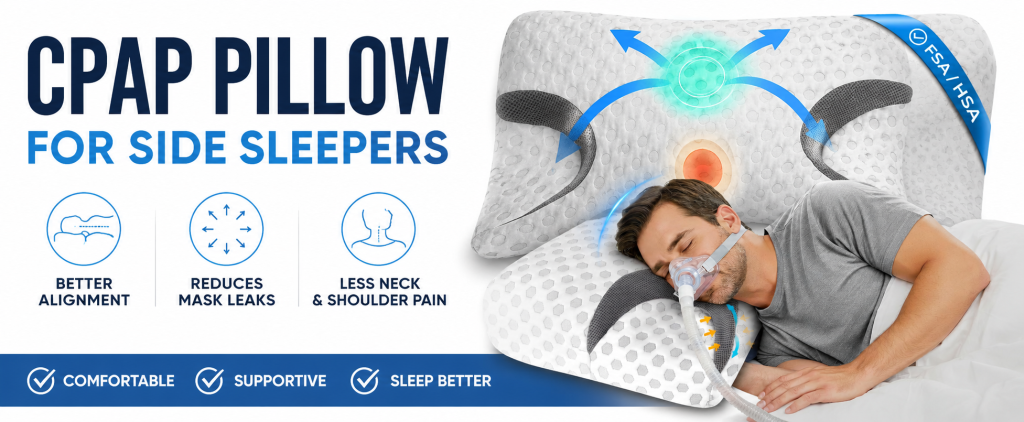
- Consider looking into a CPAP pillow made for side sleepers as well.
- If your mouth falls open at night, ask about a chin strap, mouth tape or switching to a full face mask
- Try a different mask style or size. Nasal masks tend to leak less than full face masks, so this may be worth discussing if you’re currently on a full face mask
- Wash the cushion daily with mild soap and water or CPAP wipes, since facial oils and skin care products break down the silicone seal faster
Who to talk to
Your respiratory therapist is the best first call for a hands-on refit and to try different mask sizes or styles. Your DME (durable medical equipment) supplier can pull your leak data from the machine and help you exchange your mask or cushion, often at no extra cost if you’re within your supply schedule. Your sleep doctor should be looped in if leaks continue despite refitting, since they may need to adjust your pressure setting or reassess your treatment approach.
Evidence
Leak is one of the most common problems patients report on CPAP. In a study of over 1,400 long-term CPAP users, 75.4% reported leak-related problems, making it the single most common complaint among all mask side effects. Leak also has a measurable effect on how much people use their machine. In a study of 96 patients starting auto-adjusting PAP therapy, those who did not stick with treatment had significantly higher leak levels than those who did.
References
- Rotty MC, Suehs CM, Mallet JP, et al. Mask side-effects in long-term CPAP-patients impact adherence and sleepiness: the InterfaceVent real-life study. Respir Res. 2021;22(1):17.
- Valentin A, Subramanian S, Quan SF, Berry RB, Parthasarathy S. Air leak is associated with poor adherence to autoPAP therapy. Sleep. 2011;34(6):801-806.