
 By
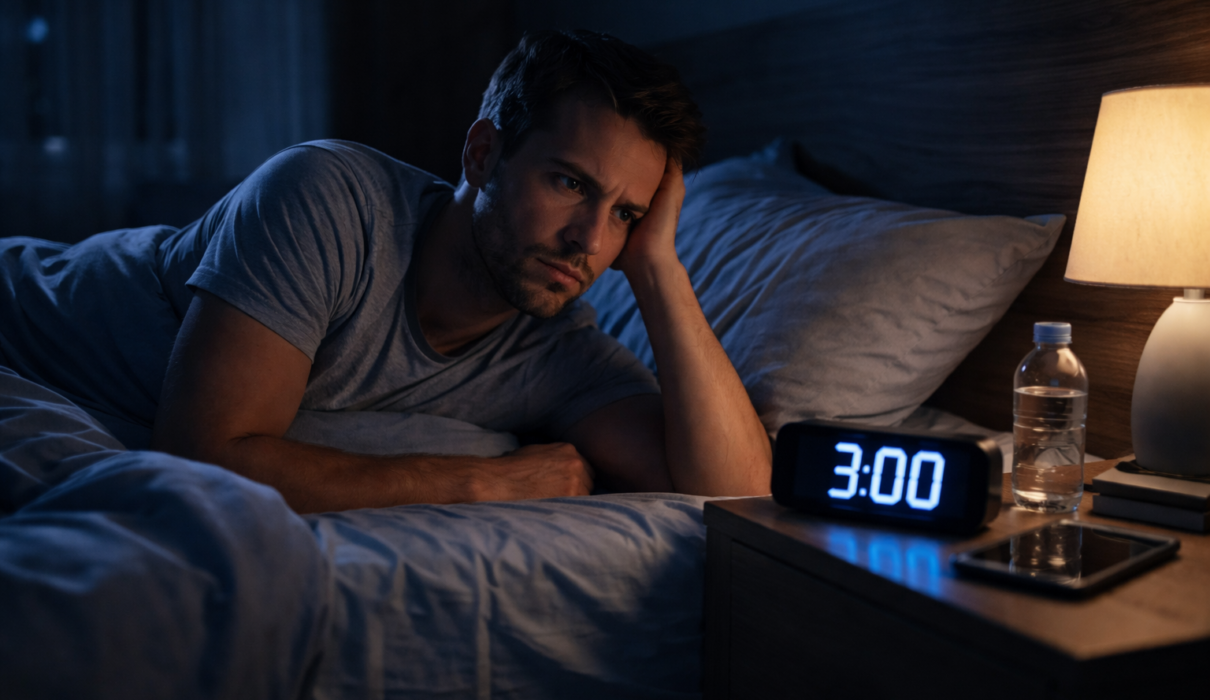
By Waking up at 3 AM every night is one of the most common sleep complaints people report. Many people worry that something is seriously wrong with their sleep when this happens repeatedly.
In reality, this pattern usually reflects a well-recognized sleep problem called sleep-maintenance insomnia, difficulty staying asleep after initially falling asleep.
Research shows that about 35% of adults wake up during the night at least three times per week, and among people with insomnia, difficulty maintaining sleep is the most common symptom, affecting around 61% of patients.
The key to solving the problem is understanding why these awakenings happen in the first place.
Insomnia Disorder (The Most Common Cause)
The most common reason people wake up around 3 AM is insomnia disorder, specifically the sleep-maintenance type.
People with this pattern usually:
- Fall asleep without difficulty
- Wake in the middle of the night
- Have trouble falling back asleep
Over time, the brain can become conditioned to wakefulness during the night. Certain behaviors can unintentionally reinforce this cycle, such as:
- Spending too much time in bed
- Irregular sleep schedules
- Checking the clock repeatedly
- Trying too hard to force sleep
When this pattern persists, insomnia often becomes chronic. Studies suggest that over half of insomnia cases follow a long-term course if the underlying drivers are not addressed.
Anxiety and Nighttime Hyperarousal
Anxiety is one of the most common contributors to middle-of-the-night awakenings.
Sleep requires the brain’s alertness systems to power down, but anxiety keeps the brain in a state of heightened vigilance, often referred to as hyperarousal.
People with anxiety frequently experience:
- Racing thoughts at night
- Sudden awakenings with a feeling of alertness
- Difficulty shutting off the mind after waking
These awakenings often occur between 2 AM and 4 AM, when sleep naturally becomes lighter.
Depression and Early Morning Awakening
Sleep disturbance is one of the core symptoms of major depressive disorder.
A classic pattern in depression is early morning awakening, where people wake several hours earlier than intended and cannot fall back asleep.
Depression alters the brain’s sleep architecture by:
- Increasing REM sleep pressure
- Shortening the time it takes to enter REM sleep
- Fragmenting the second half of the night
Because REM sleep dominates the later portion of the night, awakenings often occur during this period, commonly around 3–5 AM.
Undiagnosed Sleep Apnea
Many people who wake up during the night are surprised to learn that breathing disturbances during sleep can trigger awakenings.
Obstructive sleep apnea (OSA) occurs when the airway repeatedly collapses during sleep, causing brief interruptions in breathing.
When this happens:
- Oxygen levels drop
- The brain briefly wakes the body
- Breathing resumes
These awakenings are often so brief that people do not recognize breathing problems as the cause.
One striking study found that 90% of awakenings in patients with insomnia were preceded by breathing events, even in patients who did not report classic symptoms of sleep apnea.
Signs that sleep apnea may be involved include:
- Loud snoring
- Morning headaches
- Dry mouth upon waking
- Excessive daytime fatigue
Because untreated sleep apnea carries risks such as hypertension, heart disease, and stroke, it is an important condition to evaluate.
Circadian Rhythm Shifts
Your body follows an internal circadian clock that regulates sleep and wake timing.
Some people have a circadian rhythm that is shifted earlier than desired, a condition known as advanced sleep phase syndrome.
In this situation:
- The body becomes sleepy earlier in the evening
- The natural wake time occurs very early in the morning
This can cause awakenings around 3 or 4 AM, even if a person tries to stay up later.
Research suggests that up to 20% of people with insomnia symptoms may have an underlying circadian rhythm component.
Nocturia (Nighttime Urination)
Another common reason people wake up during the night is the need to urinate, a condition known as nocturia.
About 35% of people with insomnia report nocturia as a trigger for nighttime awakening.
Possible causes include:
- Enlarged prostate (BPH)
- Overactive bladder
- Excess fluid intake before bed
- Diabetes
- Sleep apnea
Sometimes the awakening happens first, and once awake the person becomes aware of bladder fullness.
Alcohol, Caffeine, and Medications
Certain substances can disrupt sleep and trigger awakenings during the second half of the night.
Alcohol
Although alcohol may help people fall asleep faster, it fragments sleep later in the night, often causing awakenings about 3–4 hours after sleep onset.
Caffeine
Caffeine has a half-life of 5–7 hours, meaning afternoon or evening consumption can still affect sleep well into the night.
Medications
Several medications may contribute to nighttime awakenings, including:
- Antidepressants (especially SSRIs)
- Stimulants
- Steroids
- Some blood pressure medications
Is Waking Up at 3 AM Caused by Cortisol?
Many people believe waking up at 3 AM every night is caused by a cortisol spike. While cortisol does play a role in wakefulness, the explanation is often misunderstood.
Cortisol is a hormone that follows a circadian rhythm throughout the day.
In a normal sleep cycle:
- Cortisol levels are lowest during the early part of the night
- Levels begin to gradually rise during the second half of the night
- Cortisol peaks shortly after waking in the morning, known as the cortisol awakening response
Because cortisol begins increasing in the early morning hours, the brain naturally becomes more sensitive to waking signals during this time.
However, cortisol does not normally spike suddenly at 3 AM.
In people with chronic insomnia, anxiety, or stress, the body’s stress system may be overactive, leading to elevated nighttime cortisol and other arousal hormones. This state of hyperarousal makes the brain more likely to wake up during the night.
In most cases, cortisol is not the primary cause of 3 AM awakenings, but it may contribute to the brain’s alertness if the stress system is activated.
Medical Conditions That Should Not Be Missed
Although most nighttime awakenings are related to sleep disorders or lifestyle factors, certain medical conditions should also be considered.
Hyperthyroidism
An overactive thyroid can increase metabolism and nervous system activity, making it difficult to maintain sleep.
Heart Failure
Some patients with heart failure wake suddenly due to shortness of breath when lying flat or episodes of paroxysmal nocturnal dyspnea.
Severe Sleep Apnea
Untreated sleep apnea can increase the risk of:
- High blood pressure
- Coronary artery disease
- Stroke
If nighttime awakenings occur with choking, gasping, or severe daytime fatigue, medical evaluation is recommended.
The Bottom Line
Waking up at 3 AM every night is usually not random. The most common explanations include:
- Insomnia disorder
- Anxiety or stress
- Depression
- Sleep apnea
- Circadian rhythm shifts
- Nocturia
- Alcohol, caffeine, or medication effects
Often, more than one factor contributes to the problem.
When the underlying cause is identified, effective treatment can significantly improve sleep quality and reduce nighttime awakenings.
If you experience frequent awakenings, difficulty returning to sleep, or persistent daytime fatigue, evaluation by a sleep specialist can help determine the cause and guide appropriate treatment.
References:
- Insomnia Disorder. Winkelman JW. The New England Journal of Medicine. 2015;373(15):1437-44. doi:10.1056/NEJMcp1412740.
- Management of Insomnia. Morin CM, Buysse DJ. The New England Journal of Medicine. 2024;391(3):247-258. doi:10.1056/NEJMcp2305655.
- Nocturnal Awakenings and Comorbid Disorders in the American General Population. Ohayon MM. Journal of Psychiatric Research. 2008;43(1):48-54. doi:10.1016/j.jpsychires.2008.02.001.
- Diagnostic and Statistical Manual of Mental Disorders. Dilip V. Jeste, Jeffrey A. Lieberman, David Fassler, et al. American Psychiatric Association (2022).
- Circadian Rhythms and Disorders of the Timing of Sleep. Meyer N, Harvey AG, Lockley SW, Dijk DJ. Lancet (London, England). 2022;400(10357):1061-1078. doi:10.1016/S0140-6736(22)00877-7.
- Comparing Primary Insomnia to the Insomnia Occurring in Major Depression and General Anxiety Disorder. Sun Q, Tan L. Psychiatry Research. 2019;282:112514. doi:10.1016/j.psychres.2019.112514.
- Prospective Assessment of Nocturnal Awakenings in a Case Series of Treatment-Seeking Chronic Insomnia Patients: A Pilot Study of Subjective and Objective Causes. Krakow B, Romero E, Ulibarri VA, Kikta S. Sleep. 2012;35(12):1685-92. doi:10.5665/sleep.2244.
- Circadian Aspects in the Aetiology and Pathophysiology of Insomnia. Lack LC, Micic G, Lovato N. Journal of Sleep Research. 2023;32(6):e13976. doi:10.1111/jsr.13976.
- Sleep-Related Problems in Common Medical Conditions. Parish JM. Chest. 2009;135(2):563-572. doi:10.1378/chest.08-0934.
- Chronic Insomnia. Morin CM, Benca R. Lancet (London, England). 2012;379(9821):1129-41. doi:10.1016/S0140-6736(11)60750-2.
- Diagnosis and Management of Obstructive Sleep Apnea: A Review. Gottlieb DJ, Punjabi NM. JAMA. 2020;323(14):1389-1400. doi:10.1001/jama.2020.3514.
- Alternative Treatments to Selected Medications in the 2023 American Geriatrics Society Beers Criteria®. Steinman MA. Journal of the American Geriatrics Society. 2025;73(9):2657-2677. doi:10.1111/jgs.19500.